

By Quentin Wray
When I left journalism in 2013, moved to the UK and chose to go freelance rather than look for another staff job, I knew there was a desperate need for well-written, engaging content.
And, for a decade, I made a pretty good living from it.
Then, out of nowhere for those of us not paying attention, ChatGPT and the host of other AI models burst onto the scene. With the arrogance of the comfortable, I initially dismissed the existential threat this posed to my business and just had fun with it. I got it to write poetry in the style of William McGonagall (do yourself a favour and read The Tay Bridge Disaster) and composed rude limericks about my mates. I then put it away as an unnecessary and not terribly interesting distraction.
Even when people were waking up to the threat this posed to professions like law and accounting, I thought that, as a 25-year veteran of the professional writing game, I would be fine. After all, I had survived many things: bad briefs, worse edits, clients who thought “punchier” was a strategy and the misguided belief that whatever they said was news just because they said it.
Discovering you are wrong about something is always rough. Discovering that not only were you wrong but also that your short-sightedness could kill your business is terrible.
The reality is that AI has not made anybody a good writer, despite what about 95% of posters on LinkedIn and far too many “content curators” think. That’s not the problem. The problem is that it gave everybody a fairly decent first draft and, once the first draft is free, the economics of a freelance writing business changes very quickly.
AI broke the model. Not because it could do what I do (it couldn’t and still can’t) but because not enough people pay enough attention to discern the difference.
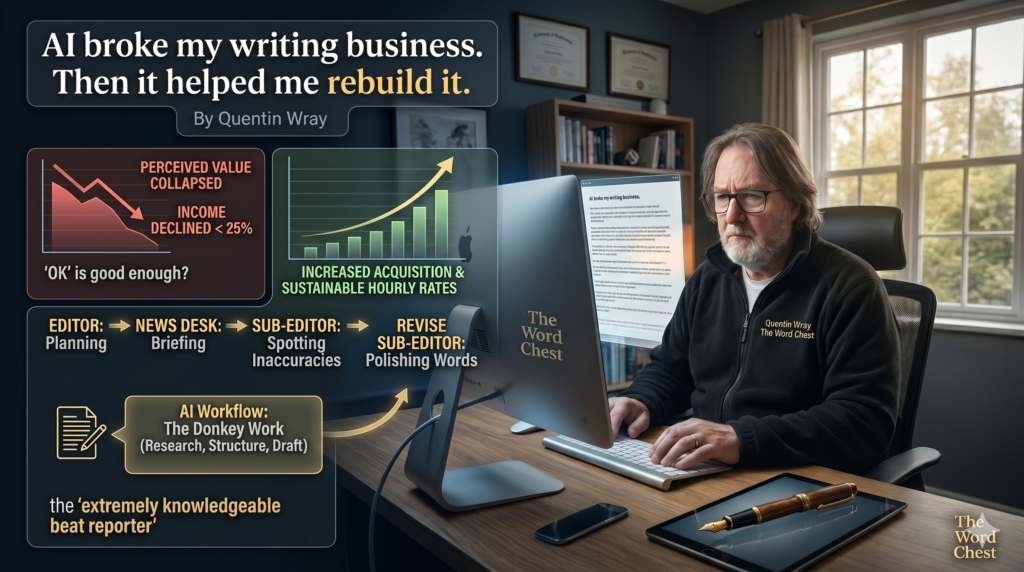
It broke because the perceived value of the words collapsed.
Clients who once needed someone to research, structure and draft from scratch suddenly had a machine that could produce something plausible, especially if you didn’t look too closely, in seconds. The fact that this was, at best, OK didn’t matter. Nor did the fact that it was frequently wrong, both factually and interpretively.
Within months my income had fallen to less than a quarter of what it had been. I tried to carry on as I had for longer than I should have mainly because, like many writers, I am very good at explaining reality to other people but quite poor at accepting it when it applies to me.
Eventually I stopped arguing with the market. It was and always is, by definition, correct.
So I changed the job.
I embraced AI and taught myself to harness it to do the donkey work, saving me hours of time and my clients hundreds of pounds. I built AI workflows that are very good at research, structure, rough drafting, comparison, summarising, repurposing, and all the heavy lifting drudgery that used to make so many decent writing projects sub-economic.
Then I do the part I have spent nearly three decades learning how to do.
I treat the AI model like I would an extremely knowledgeable and thorough beat reporter who writes like a machine wearing a lanyard but has the confidence that being blissfully unaware of your own shortcomings confers. Anyone who has sat on a newsdesk will know exactly what I’m talking about.
In newsroom terms, I now do several jobs.
- Editor: carefully planning what I want done
- News desk: properly briefing the machine, what a client jokingly calls “the team”
- Sub-editor: spotting and getting rid of inaccuracies, weak arguments, and legally or reputationally dangerous statements
- Revise sub-editor: making sure that the words do the job by removing pompous phrasing, tired rhetorical techniques, hideously rhythmic paragraph structures, atonal sentences, and jargon
That may sound less grand than “AI-enabled content strategist”, but it is far closer to the truth. The machine produces lots of words and my job is to judge which of these should survive.
The commercial result is interesting. The cost per article has dropped to a level that would not have been feasible under the old model, where I did everything from scratch. But my hourly rate has held up because the valuable bit of what I do was never about the typing.
For clarity, this is not how I treat creative writing. The novel I am writing, like the novel every writer everywhere is apparently writing, is all mine. There I use AI as a fancy Google. I ask it about the geography of a place, how to do a thing, whether a historical detail will irritate people who know the subject, and what the hell I said earlier about the protagonist’s mother’s origin story.
Commercial content is different. Businesses need accurate, useful, well-structured material at a price that makes sense. PR agencies and marketing teams need to feed websites, LinkedIn, newsletters, reports and campaigns without filling the internet with yet more barely readable, grey sludge.
That is where the new version of The Word Chest sits.
Not anti-AI. Not AI-first. Certainly not AI slop with a quick spellcheck.
AI-enabled, human-edited, commercially useful content edited (I refuse to use the word curated) by someone who believes passionately that the words still matter.
If you are a PR agency or marketing team that needs high-quality content for your clients or principals, get in touch.
It will probably be cheaper than you think.